Royal Pardon for Senegalese Supporters Aims to Mend Diplomatic Ties
In a significant development in May 2026, King Mohammed VI of Morocco extended a royal pardon to fifteen Senegalese football supporters who had been incarcerated in the Kingdom. This act of clemency follows the contentious final of the Africa Cup of Nations (CAN 2025) and is widely perceived as a strategic diplomatic maneuver to alleviate strained relations between Rabat and Dakar, particularly in the lead-up to the Eid al-Adha (Tabaski) celebrations.
The Aftermath of the CAN 2025 Final: From Pitch to Courtroom
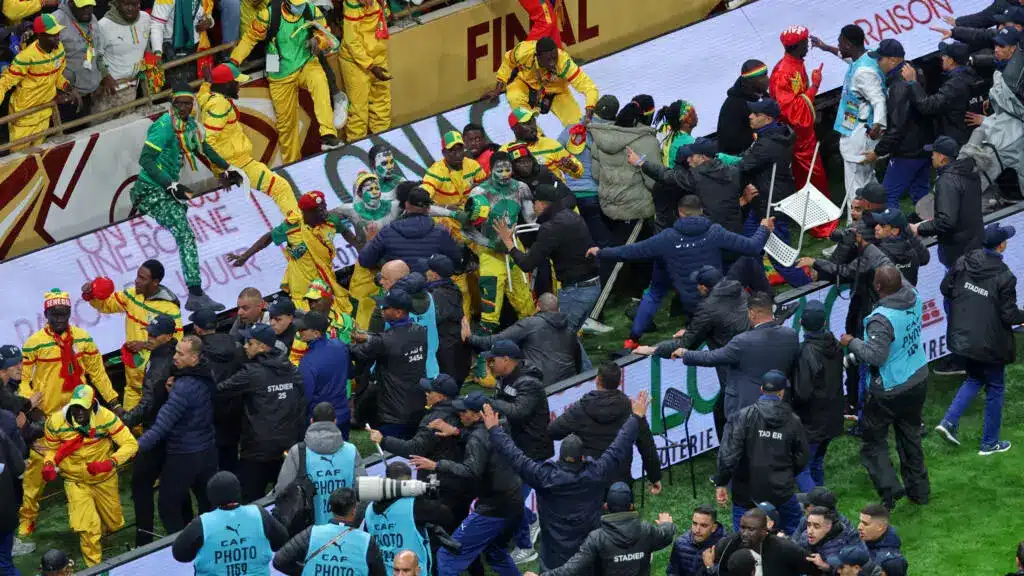
The origins of the diplomatic friction trace back to mid-January 2026, when the CAN 2025 final was held at the Moulay Abdellah Stadium in Rabat. The match, which saw Senegal triumph over Morocco with a 1-0 victory, was marred by controversy. A penalty awarded to Morocco in injury time, coupled with an earlier disallowed goal for Senegal's 'Lions of Teranga,' ignited a volatile atmosphere. Reports indicated that a segment of Senegalese supporters attempted to enter the field and threw projectiles. The Senegalese team, along with their coach Pape Thiaw, reportedly left the pitch in protest.
Morocco's judicial response to these events was characterized by its firm stance. Authorities, utilizing surveillance footage and citing injuries sustained by law enforcement personnel, as well as property damages estimated at over 370,000 euros, initiated legal proceedings. In February, a court delivered sentences ranging from three months to one year in prison for hooliganism. Despite denials from the defense, eighteen supporters were initially imprisoned. Three of these individuals completed their sentences, leaving fifteen awaiting their fate in Moroccan detention facilities until the recent royal pardon.
A Diplomatic Breakthrough: Rabat-Dakar Relations Stabilize
The Moroccan Royal Cabinet's official statement cited "humanitarian considerations" and the "long-standing fraternal relations" between Morocco and Senegal as the basis for the amnesty. Me Patrick Kabou, the lawyer representing the supporters, confirmed their immediate release, expressing relief and stating that the decision brought "joy to the hearts" of the families, especially with the impending religious holidays.
The announcement also had a palpable effect on social media platforms, where xenophobic and racist remarks between individuals from both nations had been escalating for months. The tension notably subsided. In Casablanca, the decision was largely welcomed by citizens as a wise political move that promotes reconciliation and safeguards future relations. Senegalese President Bassirou Diomaye Faye promptly acknowledged the development on the social media platform X, extending his "most sincere thanks" to King Mohammed VI for the compassionate decision and confirming the imminent return of the Senegalese nationals to their families.
The Broader Implications: Football, Diplomacy, and National Security
The royal pardon, issued in May 2026, underscores the evolving role of football as a matter of national security and high-level diplomacy in Africa. The relationship between Rabat and Dakar is a cornerstone of Morocco's influence strategy in sub-Saharan Africa and serves as a model for economic cooperation. The prolonged incarceration of Senegalese supporters for sports-related hooliganism could have significantly undermined Morocco's soft power initiatives and fostered enduring public resentment in Senegal.
By directly intervening, King Mohammed VI effectively signals an end to the nationalist fervor, reminding both populations that state geopolitics often transcend the transient passions of sports stadiums. This intervention is seen as a move to prevent a diplomatic rupture between two historically allied nations, transforming a crisis stemming from hooliganism into an opportunity for humanitarian reconciliation. Releasing the Senegalese supporters before the Tabaski celebrations further positions Morocco as a strong political leader on the African continent.
Ongoing Institutional Challenges: The CAF and CAS Verdict
While the humanitarian aspect of the crisis appears to be resolved, the institutional dispute surrounding the CAN 2025 trophy remains. On March 17, the Confederation of African Football (CAF) controversially awarded the Africa Cup to Morocco by default, penalizing the Senegalese team for their prolonged departure from the field during the final. Senegal, however, refused to accept this decision and officially appealed to the Court of Arbitration for Sport (CAS) to challenge the ruling. The international judicial body has yet to announce a date for its verdict, indicating that a degree of tension will likely persist between the two football federations, both of whom have already faced substantial fines for unsportsmanlike conduct.
King Mohammed VI's act of royal clemency has successfully averted a critical diplomatic breakdown between these two sister nations. The question that now looms is whether the anticipated CAS verdict regarding the trophy's attribution will reignite the embers of discord, or if state-level diplomacy can permanently insulate bilateral relations from the commercial pressures and excesses of modern football.
Source: CAN 2025 : Le geste choc de Mohammed VI pour sauver l’axe Rabat-Dakar